POS for Buffet and All-You-Can-Eat Restaurants
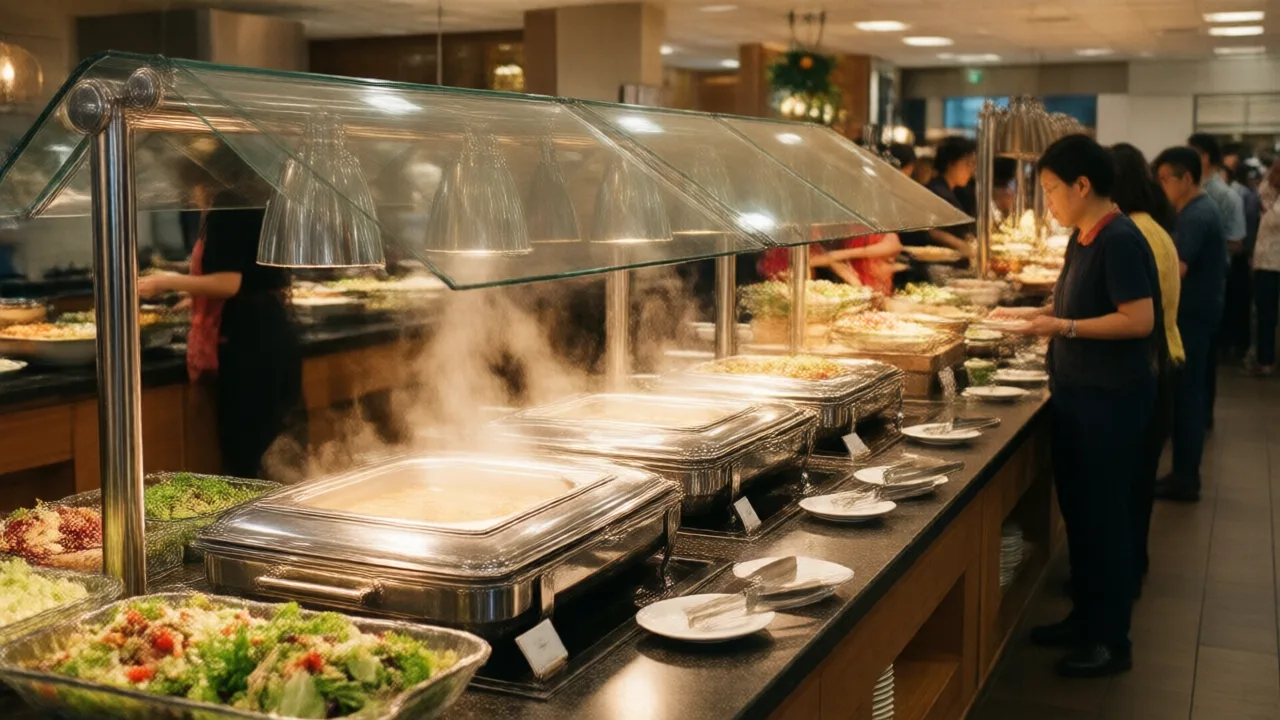
Here is a problem that shows up in almost every buffet I have walked: the register does not actually know how many people ate. A party of seven arrives, the host waves them in, a server rings "6 adult buffet" because they eyeballed the table from across the room, and a teenager who ate three plates never appears in a single report. Nobody stole anything. Nobody meant to do anything wrong. The system just was not built to make counting people the easiest action on the screen.
And the damage compounds in a way plated restaurants never experience. In a plated restaurant, an uncounted guest costs you one uncounted entrée. In a buffet, an uncounted guest costs you a full cover of revenue and consumes a full cover of food — you pay the cost twice. At a $19.99 lunch price and a $4.40 food cost per guest, every missed cover is $24.39 of damage. Four a night, six days a week, is $30,400 a year walking out the door in an operation that is otherwise running fine.
Then there is everything else the plated world never has to solve. Price changes at 3:30 p.m. when lunch becomes dinner. A kids' rate that depends on age. A senior rate. Guests who came only for the salad bar. AYCE tables on a 90-minute clock. Rounds of protein fired from a table with no printed ticket to anchor them. Most POS systems handle each of these with a workaround, and workarounds are precisely what a Saturday rush destroys. Let's walk through what the register should actually do instead.
Cover Types Are Your Menu — Build Them That Way
Start with the single decision that shapes everything downstream: buffet pricing should be built as distinct cover types, not as discounts applied to an adult price. It is tempting to code a child as "Adult Buffet − 50%," and it works fine at the register. It ruins your reporting six months later, when you cannot tell whether Tuesday was slow or simply full of children.
A functional cover structure for a mid-market buffet usually looks something like this:
| Cover type | Typical rule | Why it matters |
|---|---|---|
| Adult | Full price, varies by daypart | Your core margin driver |
| Child 4–10 | Flat rate or price per year of age | Half the food cost, needs its own count |
| Child under 3 | Free, still counted | Zero revenue but real food cost and a real seat |
| Senior 65+ | 10–15% below adult | Concentrated at lunch; skews daypart margin |
| Salad bar / soup only | Reduced price | Prevents servers from discounting ad hoc |
| Beverage only | Drink price, counted as a seat | Keeps seat occupancy honest |
Notice the last column on the free-under-3 row. A free child still occupies a chair during your peak turn and still takes food off the line. If they never appear in the count, your cost per cover is inflated and your seat-turn math is wrong. Free is a price; it is not an absence.
Make Headcount the Fastest Thing on the Screen
Once cover types exist, the entire revenue integrity of the business depends on one interaction: how quickly and accurately somebody enters the count. If that takes six taps buried two menus deep, staff will approximate under pressure, and approximation always rounds down.
What works in practice is entry at the point of seating rather than at the point of ordering. The host stand is where the guests are physically standing and countable. A single screen with large tappable counters — adults, children, seniors — that opens the check the moment the party sits, means the count is captured while it is still verifiable. By the time a server reaches the table two minutes later, the group has spread out, two people are at the salad bar, and accurate counting has become guesswork.
A few refinements that pay for themselves:
- Force the count before any other action. The check should not open without one. Making it mandatory removes the "I'll fix it later" path that never gets fixed.
- Show live seat count against floor capacity. Managers running a 180-seat room on a Sunday need to see 164 seated, not a list of table numbers.
- Log count changes with a reason and a name. Parties genuinely do shrink and grow. Silent downward edits are the single most common leakage pattern in buffet service.
- Print the count on the guest check. "4 adult buffet, 2 child buffet" gives the guest a chance to correct an honest error while it is still fixable.
Prices That Change Themselves
Buffet pricing is time-dependent in a way almost nothing else in food service is. Lunch is one price, dinner is another, weekends carry a premium, holidays carry a bigger one, and seafood night sits in its own tier. Handled manually, this is a nightly opportunity for error — and the error is asymmetric, because a manager who forgets to flip to dinner pricing at 3:30 loses $6 a cover for as long as it takes someone to notice.
Schedule-driven pricing solves it structurally. The POS holds a calendar; the calendar holds the prices. Lunch runs 11:00 to 3:30 at $14.99, dinner 3:30 to 9:00 at $21.99, Friday and Saturday dinner at $26.99 for the seafood line, and holidays get their own overrides set weeks in advance. Nobody has to remember anything on a busy Saturday, which is exactly when nobody remembers anything.
Guard the edges too. A table seated at 3:20 that pays at 4:15 should be charged at lunch pricing, because that is what the guest was told at the door — so price should lock to seating time, not payment time. It is a small rule that prevents a genuinely ugly conversation at the register roughly once a week.
AYCE Formats: The Clock and the Rounds
Cook-to-order all-you-can-eat — Korean barbecue, hot pot, sushi AYCE, churrasco — adds two mechanics that pure hot-line buffets never deal with, and both belong in the POS rather than in a server's memory.
The clock. Most AYCE formats run a 90- or 120-minute limit, which exists to protect turns on a Saturday, not to rush guests. Enforcement only works if it is systematic: the check timestamps at seating, the floor view shows elapsed time per table, and the system nudges the team at the 15-minutes-remaining mark so last call happens gracefully instead of abruptly. On a 120-seat AYCE room turning 2.4 times a night at a $32 cover, tightening average table time by eleven minutes is worth roughly one extra turn on a third of your tables — about $1,200 a night.
The rounds. AYCE protein comes in waves, and each wave needs to reach the right table in the right order. This is genuine kitchen-routing work, which is why cook-to-order AYCE benefits from kitchen display screens even though no one is ordering from a menu in the conventional sense. Rounds get sequenced, timestamped, and bumped against a table number rather than a ticket. It also gives you the data behind the most important AYCE control there is: consumption per cover by round, which tells you whether your $32 price is holding up against a table that ordered nine rounds of short rib.
Most AYCE operations also enforce a waste rule — uneaten protein billed at à la carte price — and that rule should exist as a chargeable item on the check with a note field, not as an awkward improvisation by a 22-year-old server.
Real Numbers: A 180-Seat Indian Buffet Finds Its Missing Covers
A suburban Indian buffet doing about $1.9M a year suspected it was undercounting but could not prove it. The owner ran a two-week manual audit: a manager clicked a physical counter at the door during lunch service and compared it to POS covers at close. The gap averaged 9.4 covers per lunch shift — roughly 6% of traffic — concentrated on large family tables where servers estimated instead of counted. At a $16.99 lunch price, that was about $160 a shift, or $41,000 a year. The fix was structural rather than disciplinary: headcount entry moved to the host stand, became mandatory before the check would open, and the count printed on the guest slip. Within six weeks the audit gap was under one cover per shift. Food cost per guest also became a usable number for the first time — it came in at $4.12 against a $16.99 price, and that clarity let them add a weekend seafood tier at $24.99 with confidence rather than hope.
Cost Per Cover: The Only Food Cost Number That Works Here
Traditional food costing assumes a recipe behind every sale. Buffets break that assumption completely — nobody rings up the third trip to the tandoori station. So the metric changes shape: instead of cost per item, you track cost per cover, and the accuracy of that number depends entirely on the accuracy of the headcount you just fixed.
The calculation is simple, and its simplicity is the point. Total everything that hit the line for a shift — including pans pulled early and discarded — then divide by covers. A Saturday dinner that pushes $2,900 in food for 640 guests is $4.53 per cover; against a $21.99 price, that is a 20.6% food cost. Track it daily and patterns surface fast: Sunday brunch runs richer because of the carving station, Wednesday runs lean, and the seafood tier only works when covers clear 400.
From there, the discipline is about what goes on the line rather than what leaves the kitchen. Pan-level tracking of what was put out versus what came back is the buffet equivalent of a waste log, and it is where the biggest savings hide — the same principle behind using data to cut food waste with your POS. Pair it with disciplined inventory tracking on high-cost proteins and you can finally answer the question every buffet owner asks: is the crab legs station paying for itself, or is it marketing? For operators running a full Indian buffet line, this deep dive on Indian buffet operations covers the pan rotation and batch-timing side of the same problem.
Where the Actual Margin Lives
One more thing that separates buffets that thrive from buffets that grind: the buffet price is rarely where the profit is. Beverages are. A $3.49 fountain drink at roughly 20 cents of cost is close to pure margin, and on a $19.99 cover it can move total check margin by several points single-handedly.
Which means the POS should make the beverage prompt unavoidable. When a cover is added, the next screen asks about drinks — not as a nag, but because a guest who has already been seated and counted is the easiest upsell in the building. Track beverage attach rate per server and the number tends to correct itself within a month; teams that measure it commonly run 15 to 20 points higher than teams that do not. The same logic extends to desserts sold à la carte alongside an included dessert bar, and to alcohol at dinner service, where a single $9 beer can outperform the food margin of the entire cover.
Hybrid formats deserve a mention here too. Plenty of buffets run à la carte alongside the line — a dinner menu at night, or premium add-ons like a whole fish or a tandoori platter. The register needs to carry both on one check without confusion, which is closer to a quick-service ordering flow layered on top of cover-based pricing. Systems that treat buffet mode and menu mode as separate universes force staff to open two checks, and two checks on one table is how comps and voids multiply.
Sell Seats, Not Guesses
KwickOS handles per-person pricing, age tiers, scheduled daypart rates, AYCE time limits, and cost-per-cover reporting as first-class features — so your headcount is captured at the door and your food cost per guest is a number you can trust.
Review the KwickOS buyer checklist →A Short Checklist Before You Buy
If you are evaluating systems, ignore the feature grid and test six things during the demo. Can you enter a headcount in one screen at the host stand? Can a price change itself at 3:30 without anyone touching it? Does a free child still show up in the cover count? Does the floor view display elapsed time per table? Can you pull cost per cover for a single shift? And can one check hold both buffet covers and à la carte items without a workaround? A system that clears all six will feel dramatically different on a Saturday than one that clears four.
Buffet service looks like the simplest format in the industry — one price, help yourself — and it is actually one of the most operationally demanding, because the register has to measure something no plate ever passes through. Get the count right and everything else becomes solvable arithmetic. For a broader look at how casual-dining floors handle high-volume seating and turns, the casual dining POS overview covers the table-management side that buffets share with the rest of the category.
The Bottom Line
Everything in a buffet reduces to one number: how many people ate. Get it right and cost per cover becomes real, pricing tiers become testable, and your margin becomes something you manage instead of something you discover at month end. Get it wrong by four covers a night and you lose the equivalent of a full-time employee's wages without a single line item ever showing it. Make counting people the easiest thing your staff does all shift, and the rest of the buffet math finally starts working in your favor.