What Is a Processor-Agnostic POS? Why Payment Lock-In Costs You
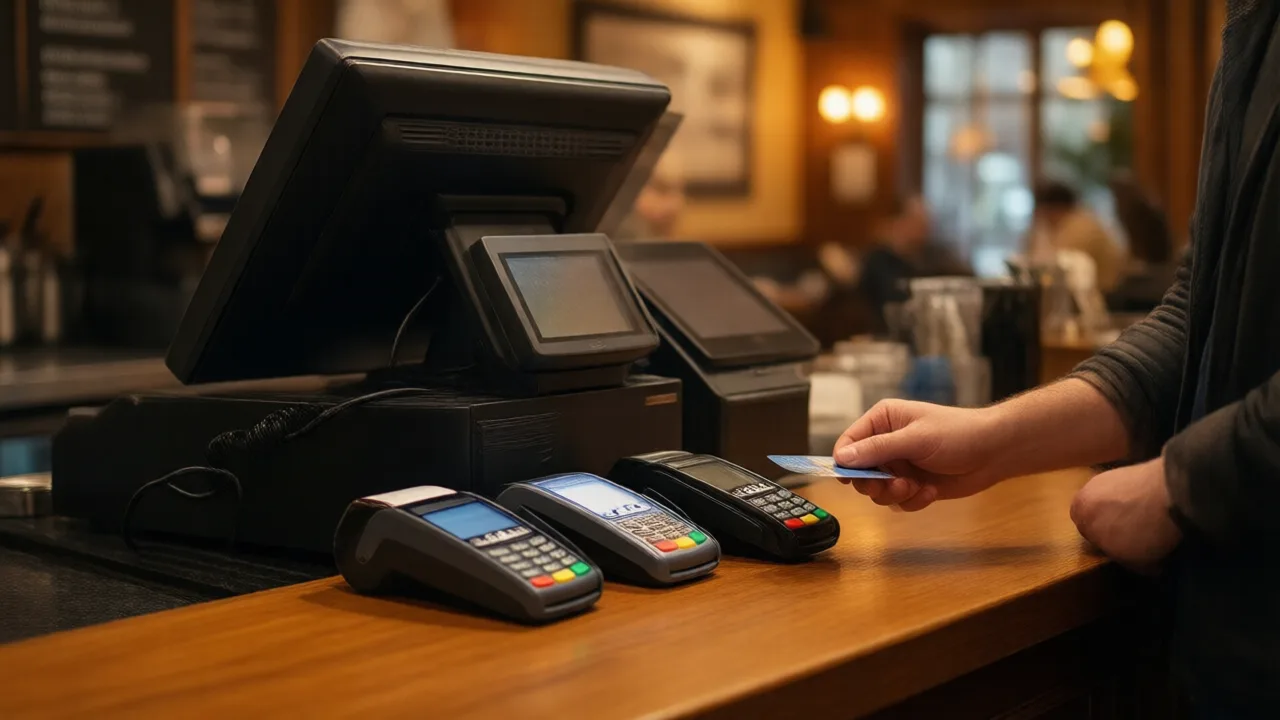
A processor-agnostic POS is a point-of-sale system whose software is independent of the company that moves your card money. You pick the processor, you negotiate the rate, and when a better deal shows up you change processors while keeping the same terminals, menu, and reporting. The register and the money are two separate contracts instead of one.
That definition sounds like plumbing trivia until you price it out. Payment processing is almost always the largest technology expense in a restaurant — usually four to eight times what the POS software itself costs — and it is the one line item most operators have never once put out to bid. The reason is rarely laziness. It is that the system they bought quietly removed the option.
The Distinction Nobody Explains at the Demo
Every POS demo covers the same ground: how fast you can fire a modifier, how the floor plan looks, how the reports break down by daypart. What almost never comes up is a structural question worth more than all of it — can this software send a card transaction to a processor of my choosing?
There are two architectures behind the same-looking screen. In a bundled or closed-loop system, the POS vendor is also your merchant services provider. Your card rate is set by the same company that sets your software fee, and the payment stack is deliberately fused to the software. In a processor-agnostic or open system, the POS speaks a documented payment interface, and any certified processor on the other side can answer.
Here is why that architectural choice becomes a financial one: in a bundled system, your leverage on rates is exactly zero. You cannot credibly threaten to leave, because leaving means ripping out terminals, rebuilding a 300-item menu, retraining staff, and re-cabling a kitchen. The processor knows that. Pricing tends to reflect what a customer who cannot leave will tolerate, not what the market would offer.
The Three Models You Will Actually Encounter
Vendors rarely use the word "locked," so the labels below matter more than the marketing:
| Model | Who sets your card rate | Cost to change processors |
|---|---|---|
| Bundled / closed-loop | The POS vendor | Replace the entire POS |
| Preferred-partner (semi-open) | A short list the vendor approves | Moderate: re-certification, new keys |
| Processor-agnostic / open | You, by competitive bid | Low: new merchant account, re-keyed readers |
The middle model is where most confusion lives. A vendor that supports "several payment partners" is more open than a closed-loop platform, but if the approved list contains three processors who all quote within five basis points of each other, the competition is theatrical. Ask for the actual list, then call two of them and compare quotes before you believe it.
What Lock-In Costs in Real Dollars
Abstractions do not persuade anybody, so let's run the arithmetic on an ordinary restaurant: $80,000 a month in card volume, roughly 3,200 transactions, an average ticket near $25.
| Scenario | Effective rate | Monthly cost | Annual cost |
|---|---|---|---|
| Bundled platform rate | 2.85% + $0.15 | $2,760 | $33,120 |
| Competitively bid rate | 2.45% + $0.10 | $2,280 | $27,360 |
| Difference | 0.40 pts + $0.05 | $480 | $5,760 |
Nearly $5,800 a year, on the same sales, running the same software, serving the same guests. And notice what it is not: it is not a discount you earned by cutting portions or squeezing labor. It is a negotiation you were structurally prevented from having.
Now stretch the timeline. Card volumes grow, and a percentage-based fee grows with them. Over a five-year hardware cycle, that same restaurant hands over somewhere near $30,000 in avoidable processing — more than the entire cost of the POS hardware and software combined. This is exactly the dynamic that hides inside a POS cost breakdown: the visible number is the software fee, and the expensive number is the one nobody put on the comparison sheet.
There is a subtler cost too. When processing is bundled, rate increases arrive as a line in an email addendum rather than a renegotiation. A tenth of a point here, a new "network access fee" there. Operators with an open system catch those and push back. Operators without one usually discover them a year later while reconciling statements — a pattern we cover in more depth in our guide to restaurant payment processing fees.
Where Your Rate Actually Comes From
To negotiate anything you first need to know which part of the number is negotiable, and on a card statement only one part ever is. Every swipe carries three layers of cost. Interchange goes to the bank that issued the guest's card and is set by the card networks — nobody sells it to you cheaper, not your processor, not your POS vendor. Assessments go to Visa and Mastercard themselves, and they are likewise fixed. The third layer is the processor markup, and that is the entire negotiation. It is typically somewhere between 0.15% and 0.85% depending on how hard anyone competed for your business.
This is why bundled pricing can look reasonable and still be expensive. A flat 2.75% quote is not a rate so much as an average, and it deliberately blends the fixed layers with the negotiable one so you can never see how large the markup is. On a debit-heavy quick-service mix where true interchange might land near 1.10%, a flat 2.75% is an enormous markup. On a rewards-card-heavy fine-dining mix where interchange runs closer to 2.10%, the same 2.75% is fairly thin. Identical headline, opposite verdicts.
An interchange-plus quote separates the layers on purpose: you see pass-through interchange, then a stated markup like "plus 0.25% and $0.08." Two bids in that format are directly comparable in about thirty seconds. And the only way to collect two comparable bids in the first place is to be running a system that lets a second processor answer the phone.
Five Questions That Reveal What You Signed
Whether you are shopping or already live, these five questions cut through the sales vocabulary in about ten minutes:
- "If I move my processing to another provider next month, does my POS keep working?" Yes with names attached means open. Any answer containing "integrated," "bundled," or "part of the platform" means locked.
- "Who holds my merchant agreement?" If it is the POS company, they own the relationship, the rate, and the reserve terms. If it is a separate processor, you have a lever.
- "Which processors are certified with your software today?" Ask for the list in writing. Two names is a preference; six or more is a market.
- "Are the card readers semi-integrated?" Semi-integrated devices talk to the processor directly and hand the POS only an approval, which both narrows PCI scope and makes swapping providers far cleaner.
- "What is my early termination fee, and does it apply to the processing agreement, the software agreement, or both?" Two agreements with two exit clauses is a very different risk than one.
The tell is usually in the tone of the answer, not the content. Vendors who built for openness answer question one instantly, because it is a feature they sell. Vendors who built a closed loop pivot toward how competitive their bundled rate already is — which may even be true, but it dodges the question you asked.
Real Numbers: A Three-Location Group Rebids and Keeps Its Registers
A three-unit fast-casual group in Arizona was running about $265,000 a month in combined card volume on a bundled platform at 2.79% plus $0.12. They liked the software and had no interest in retraining 40 staff members, so switching POS was never realistically on the table — which was precisely the problem. When they migrated to a processor-agnostic system during a planned hardware refresh, they put processing out to bid for the first time in four years and took quotes from three providers. The winning bid came in at 2.41% plus $0.08, a saving of about $1,110 a month, or roughly $13,300 a year across the group. The migration cost them new card readers at $1,850 total and one slow Tuesday of staff training. Two years later they rebid again and picked up another eight basis points — the second saving being, in a sense, the real point: the leverage did not expire.
When a Bundled System Is Genuinely the Right Call
Fairness matters here, because "open is always better" is a slogan, not analysis. Bundled platforms earn their place in a few real situations.
If you run under roughly $20,000 a month in card volume, independent processors will not fight hard for your account, and the flat-rate simplicity of a bundled provider is often priced comparably to what you would negotiate anyway. If you are opening your first location and have never underwritten a merchant account, the single-vendor path removes a genuinely confusing step during the hardest month of your business life. And if your operation depends on one specific bundled feature — an instant-deposit product, a lending facility tied to card volume — that may be worth paying for with your flexibility.
The distinction worth holding onto is this: bundled pricing is fine as a choice and dangerous as a default. If you knowingly trade leverage for simplicity at $15,000 a month, that is a reasonable trade. The trouble starts when the same restaurant is doing $95,000 a month three years later and the trade was never revisited, because nobody ever framed it as a trade at all.
How to Move Without Breaking Your Floor
Operators who avoid this decision usually do so out of a well-earned fear of downtime. Fair — a botched cutover during a Friday dinner is a genuinely bad night. But a processor migration on an open POS is a narrower project than a full platform replacement, and it follows a predictable sequence.
- Collect three months of statements first. Effective rate is total fees divided by total volume. Quote against that number, not against a headline rate, or you will be comparing marketing to arithmetic.
- Bid at least three processors, and ask for interchange-plus. Tiered pricing hides the markup by design; interchange-plus states it as a number you can compare across bids.
- Confirm certification before signing. "We work with that POS" should mean a live certification, not a roadmap item. Ask for a reference restaurant on your exact version.
- Schedule the cutover for your slowest daypart and keep the old readers plugged in until the first full day of clean batches has settled.
- Reconcile the first two batches by hand. Tip handling, offline approvals, and refund routing are where mismatches surface, and both are far easier to fix on day one than in a month-end close.
Most single-location migrations run one to two weeks end to end, with the actual switch measured in hours. If you are also weighing a broader platform change, the sequencing advice in our guide to switching POS systems without downtime applies almost line for line — the same principle of proving the new path on a slow shift before trusting it on a busy one. For a deeper look at the operational upside beyond rate savings, this breakdown of processor-agnostic POS benefits walks through the reporting and continuity advantages that come with separating the two systems.
The Contract Language to Read Twice
One last practical note, because the architecture can be open while the paperwork quietly is not. Look specifically for an exclusivity clause that names a processor, an auto-renewal term that rolls the processing agreement forward on a different clock than the software agreement, and any liquidated damages formula that prices your exit as a multiple of past monthly fees. Any of the three can turn a technically agnostic system into a practically locked one for three more years.
If you are shopping vendors right now, it is worth seeing how a platform that treats processing as a separate decision presents its pricing — this side-by-side comparison of two major restaurant POS approaches lays out how differently the two models handle the payment side of the contract.
Keep the Register. Change the Processor.
KwickOS is processor-agnostic by design — you choose your payment provider, rebid it whenever the market moves, and keep the same terminals, menu, and reporting throughout. No exclusivity clause, no rate you cannot negotiate.
Review the KwickOS buyer checklist →The Bottom Line
Processor-agnostic is not a feature you notice on a busy Saturday. Nobody has ever complimented a restaurant on its payment architecture. What it buys you is the ability to have a conversation — an annual, unglamorous, entirely winnable conversation about basis points that most operators never get to have. On $80,000 a month, that conversation is worth close to $5,800 a year, and it is worth roughly that much again every year you keep having it. Before you sign anything, ask the one question that settles it: if I change processors next month, does this system still work? The answer tells you who is holding the leverage for the next five years.