What Is the Best POS System for Bakeries and Cafes in 2026?
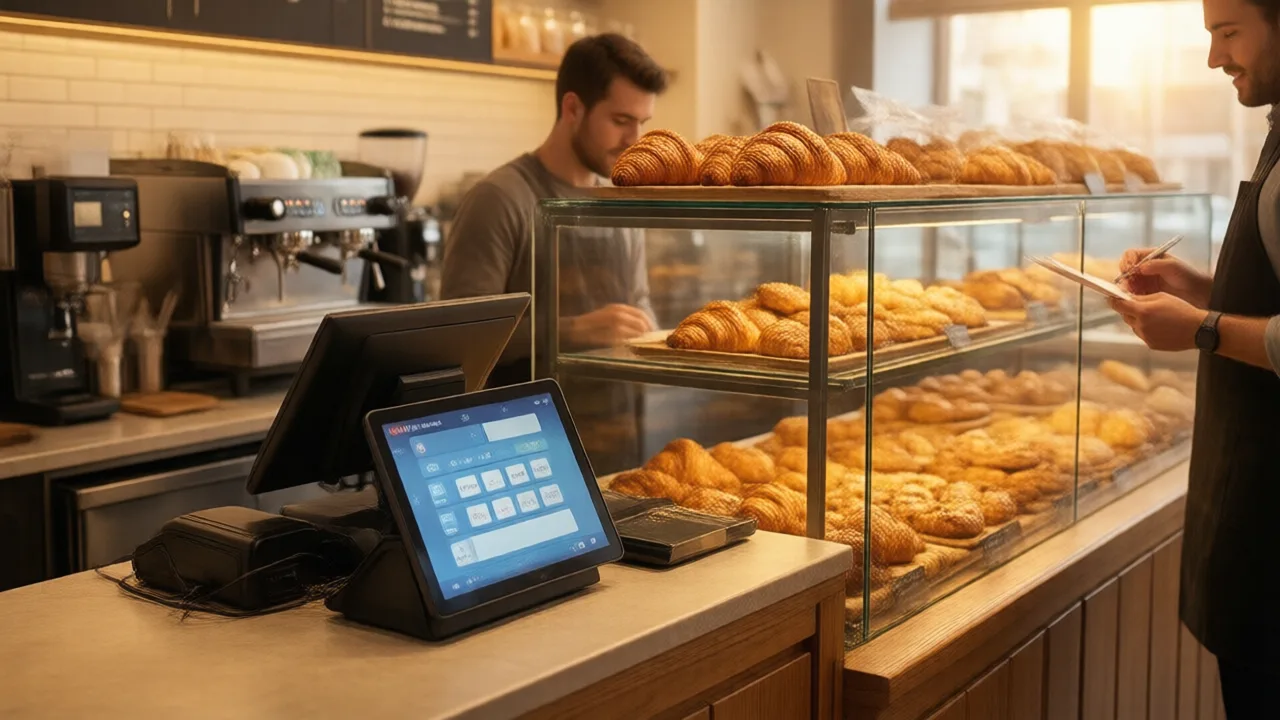
The best POS system for a bakery or cafe is one built for a genuinely hybrid operation: it handles fast counter transactions like a retail store, made-to-order drinks like a coffee shop, and perishable production like a kitchen — all from a single catalog and a single set of reports. That combination is rarer than the marketing suggests, because most systems were designed for one of those three jobs and had the other two grafted on later.
That distinction matters more here than in almost any other food business. A bakery-cafe rings a high count of very small tickets, sells the same croissant three different ways, weighs some items and counts others, and throws away unsold product every single night. A POS that ignores any one of those realities does not just annoy your staff — it quietly leaks money in a business whose margins were already thin to begin with.
Why a Bakery-Cafe Isn't Just a Small Restaurant
Walk a vendor through your day and the mismatch shows up fast. A full-service restaurant POS is optimized around tables, courses, coursing, and check-splitting. Your morning has none of those. What it has instead is a line of twelve people who each want to be gone in under ninety seconds, half of them ordering a drink that needs to reach a barista, the other half pointing at a case of items priced by the piece and the pound.
Here's the thing most buyers discover too late: the features that make a restaurant POS impressive at dinner are dead weight at 7:40 a.m. Table maps, seat-level modifiers, and elaborate coursing screens are steps you have to tap past to reach the ten items that are 80% of your sales. Speed is not a nice-to-have at a bakery counter; it is the entire product. This is the same core lesson in any solid POS buying guide for a new food business — buy for the shift that actually decides your day.
Underneath the counter sits a second reality: production. Unlike a restaurant that fires dishes to order, a bakery makes inventory hours before it sells, and what does not sell is gone. Your POS has to connect the sale back to a recipe and an ingredient count, or you are flying blind on the two numbers that decide a bakery's survival — food cost and waste.
The Non-Negotiable Features
Strip away the demo theater and a bakery-cafe POS earns its keep on a short list of capabilities. Everything else is preference; these are the ones whose absence you will feel every day.
- Sell by weight from an integrated scale. If you move bread, cookies, or bulk items by the pound, the register must read a certified scale directly and price the item itself. Hand-keying weights produces two equally expensive errors — overcharging that irritates regulars and undercharging that silently erodes margin.
- For-here versus to-go tax handling. In many states the same muffin is taxed one way eaten in and another way boxed to go. The POS should switch the tax rule on a single prompt, not force a manager override, or you will fail an audit you did not know you were taking.
- Fast modifiers for the beverage bar. Oat milk, an extra shot, half-caf, a syrup, hot or iced — these should be two taps, not a submenu dive, and they should print or display cleanly at the espresso station.
- Recipe-linked inventory. Selling a loaf should decrement flour, and the day's unsold count should be one report, not a clipboard. Tying sales to ingredients is how you catch food cost creep before it eats the quarter, a discipline covered well in this guide to tracking perishable ingredient costs.
- Offline mode. If the internet drops during the rush, the register must keep ringing sales and sync when it recovers. A cafe that stops taking cards for twenty minutes at 8 a.m. loses both the sales and the trust.
Weight, Counts, and Grab-and-Go: The Retail Side
The single biggest reason a restaurant POS disappoints a bakery is that it cannot properly sell things that are not plated dishes. A dozen mixed cookies, a half-pound of granola, a loaf priced by weight, a pre-packaged sandwich with a barcode — these are retail transactions, and they need retail tools: barcode scanning, price-by-weight, and open-item entry that still reports cleanly by category.
Consider the grab-and-go case specifically. Many bakery-cafes now earn a meaningful slice of revenue from packaged salads, sandwiches, and cold drinks a customer grabs and pays for without a word. A POS that can scan a label and complete that sale in three seconds turns your case into a self-selecting revenue stream. One that requires a cashier to hunt through menu screens turns the same case into a bottleneck. If self-service is part of your plan, it is worth reading how a self-service kiosk extends that same grab-and-go logic to the customer's own hands.
Speed at the Morning Rush
Every bakery-cafe lives or dies in a two-hour window, and the POS is either an accelerant or a brake. The math is unforgiving: shave four seconds off the average order on a line that serves 120 people between 7 and 9, and you have handed roughly eight minutes back to the rush — often the difference between the last three regulars staying or walking.
What actually creates that speed is unglamorous. A pinned favorites screen holding the ten top sellers. Saved orders for regulars, so "the usual" is a single tap. Contactless payment that clears in a second. And a layout designed so a new hire in week one can find a plain croissant without asking. When you evaluate a system, do not watch the polished demo — ask to ring your own ten most common orders and count the taps.
What a Bakery-Cafe POS Should Cost
Pricing splits into three buckets: software, hardware, and processing. The first two are predictable; the third is where the real money moves, and it is the one most owners never scrutinize.
| Setup | Software / month | Hardware (up front) | Best for |
|---|---|---|---|
| Single counter, tablet-based | $60–$90 | $700–$1,200 | Coffee shop, small cafe |
| Bakery + scale + prep display | $90–$130 | $2,500–$4,500 | Retail bakery with production |
| Multi-register bakery-cafe | $130–$165 per terminal | $5,000+ | High-volume or multi-location |
Those software numbers are real, but they are not the number that decides your year. On a bakery-cafe doing $60,000 a month in card volume, processing at a bundled 2.85% costs about $1,710 a month, while a competitively negotiated 2.45% runs closer to $1,470 — a gap near $2,900 a year on identical sales. That is why the software price on the quote sheet deserves less of your attention than the processing rate buried underneath it. The full picture, and the fees vendors leave off the demo, is laid out in our POS cost breakdown of hidden fees.
Real Numbers: A Neighborhood Bakery-Cafe Cuts Its Close by 40 Minutes
A single-location bakery-cafe in Oregon was running a well-known quick-service restaurant POS that could not weigh product. Staff hand-keyed bulk cookie and bread prices, and the nightly close meant reconciling a paper waste sheet against the register by hand — about an hour every night. After moving to a scale-integrated hybrid system, weighed items priced themselves at the counter, and recipe-linked inventory turned the waste sheet into a single automated report. The owner clocked the nightly close dropping from roughly 60 minutes to about 20. More quietly, correctly-priced weighed sales lifted recorded bulk revenue by an estimated 4% — not because prices rose, but because the undercharging that came from rushed manual entry finally stopped. The hardware upgrade, a certified scale and a second reader, paid for itself inside a single quarter.
Matching the System to Your Format
"Bakery-cafe" covers three quite different operations, and the right answer shifts with yours.
A coffee-forward cafe with a small pastry case leans hardest on beverage modifiers, speed, and mobile or online ordering — the retail-scale features matter less. A production bakery with a counter flips that priority: scale integration and recipe-linked inventory are the whole game, and the drink menu is secondary. A true hybrid bakery-cafe needs both at full strength, which is exactly where single-purpose systems fail and a genuinely unified platform earns its price. The trap to avoid is buying for the business you photograph rather than the one you run — the pretty espresso pours photograph well, but if half your revenue is weighed bread, a POS that cannot weigh is the wrong tool no matter how good the latte art looks.
If catering or standing wholesale orders are part of your mix — a standing hotel bread order, a weekly office pastry drop — the requirements broaden again toward invoicing and scheduled production, which we cover in our look at the best POS for catering businesses.
Five Questions Before You Buy
These five cut through a sales pitch faster than any feature sheet:
- "Can the register price an item straight from a certified scale?" If you sell anything by weight, a "no" or a "with a workaround" ends the conversation.
- "How many taps to ring my ten most common orders?" Make them prove it on your menu, not their demo one.
- "Does it switch tax automatically for here versus to go?" A manager-override-only answer is a daily friction point and an audit risk.
- "Does selling a product reduce its ingredients in inventory?" Recipe-linked inventory is how a bakery controls the two numbers — food cost and waste — that decide whether it survives.
- "What happens to sales if the internet goes down at 8 a.m.?" "It keeps ringing and syncs later" is the only acceptable answer for a rush-driven business.
The revealing part is usually not the answer but the hesitation. A vendor who built for retail-plus-foodservice answers the scale and tax questions instantly because they are features they sell. A restaurant-first vendor pivots to how flexible their modifiers are — true, perhaps, but a dodge of the question you asked.
Learn More About How KwickOS Handles Bakeries and Cafes
KwickOS runs weighed retail, beverage modifiers, for-here-versus-to-go tax, and recipe-linked inventory from one system — the hybrid setup a bakery-cafe actually needs, not a restaurant POS with a pastry on the box.
Learn more about how KwickOS handles bakeries and cafes →The Bottom Line
There is no single "best" bakery-cafe POS in the abstract — there is the best one for a business that sells by weight and by the piece, rings a hundred tiny tickets in two hours, taxes the same item two ways, and discards unsold product every night. That is a specific and demanding profile, and it rules out most systems that look fine in a five-minute demo. Judge candidates on the unglamorous fundamentals — can it weigh, can it ring your top ten in two taps, can it tie a sale back to a recipe, and does it keep working when the connection drops. Get those four right and the rest is preference. Get any one of them wrong and you will feel it every single morning.